Guide
The main window
It works like a Finder window that already knows where everything is. The sidebar, the toolbar, columns, browsing, preview and tabs.
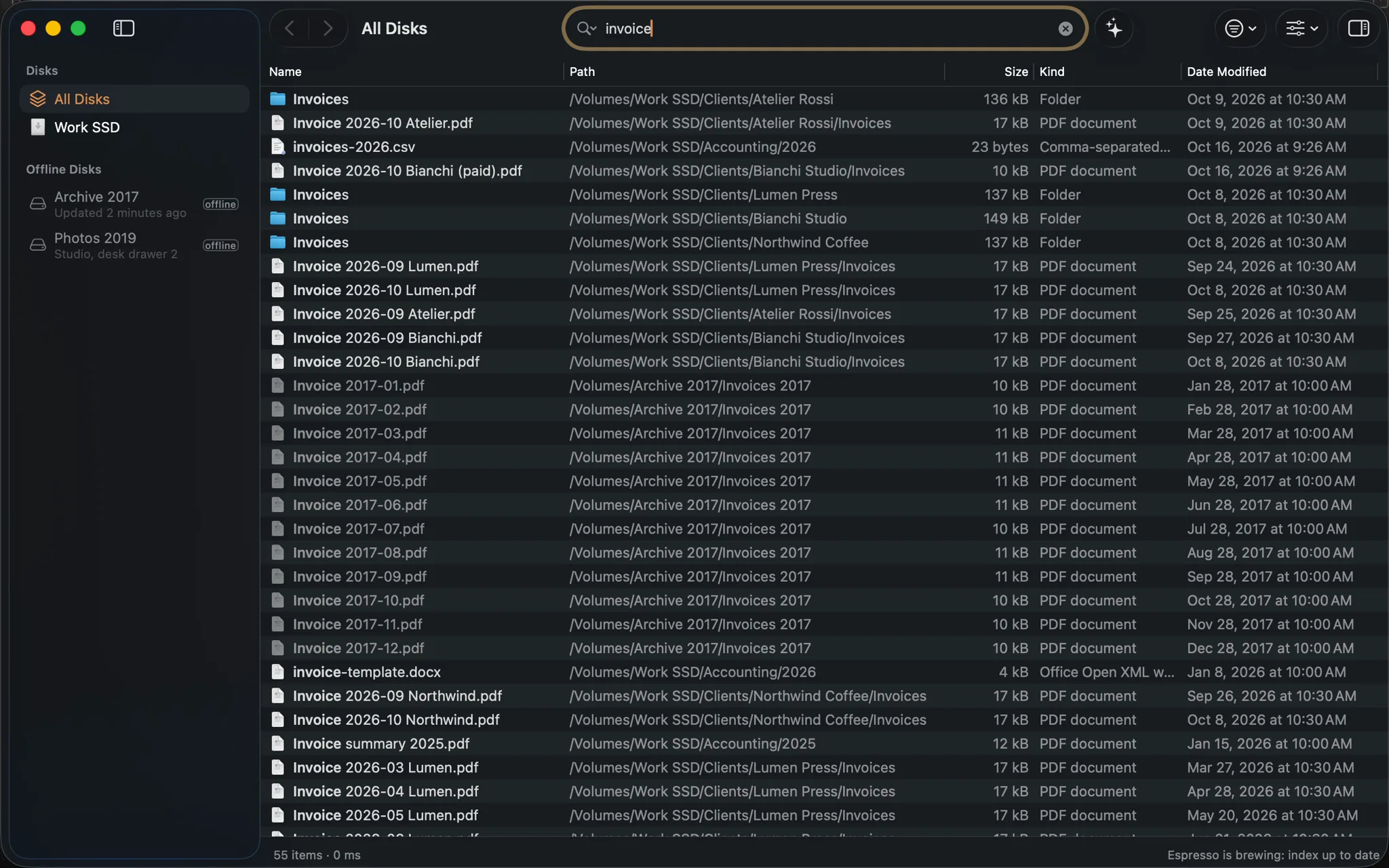
A sidebar on the left, the results in the middle, an optional preview on the right, a status bar along the bottom.
Sidebar
- Your Usual: your saved searches, once you save one.
- Disks: All Disks first, then every connected disk Espresso has indexed. A spinning indicator next to a disk means it’s being indexed.
- Offline Disks: indexed disks that aren’t connected, in grey with an offline badge, the date of their last update or, with Pro, where they’re kept. Search and browse them like any other disk.
Right-click a disk or a saved search for more (see the disk menu). Hide the sidebar with View › Show Sidebar (⌃⌘S) or the button at its top.
Toolbar
| Item | Use |
|---|---|
| Back / Forward | Previous searches and folders (⌘[ ⌘]). |
| Search field | Type to search. Its menu holds your Past Orders. ⌘F puts the cursor there. |
| ✨ Ask | Pro Ask the Barista a question in your own words (⌘J). |
| Blends | Filter by kind: Images, Documents, Folders… |
| Options | Match Case, Whole Words, Path, Diacritics, Forgive Typos, Barista mode, Lungo, hidden files. |
| Preview | Show or hide the preview on the right. |
Right-click the toolbar and choose Customize Toolbar… to rearrange it.
Results
Each row is a file or folder: its name and icon, the folder that holds it, and details. Files on offline disks are grey.
Columns
- Sort: click a column header, click again to reverse. Sizes and dates start with the largest and newest. Every column except Location sorts, details included (camera, ISO, rating, duration…); items without that detail always come last.
- Resize and reorder: drag the edges of a header, or drag a header left or right.
- Show or hide: right-click any header and pick from Path, Disk, Size, Kind, Date Modified, Date Created, Dimensions, Duration, Pages, Date Taken, Tags, and with Espresso Pro Author, Title, Album, Camera, Lens, Location, Codecs, Aperture, Shutter Speed, ISO, Focal Length, Rating, Keywords, Genre, Year, Frame Rate, Bit Rate.
The Disk column appears by itself once you index a second disk. Dimensions, duration, pages, date taken and the Pro columns come from extended details. Your column layout is remembered.
Moving around
Arrow keys move through the results; ↓ in the search field jumps to the first one; start typing at any time to search again. Select several items with ⌘-click or ⇧-click.
Browsing folders
Select a disk in the sidebar and leave the search field empty: Espresso lists the disk’s top level, like Finder. Double-click a folder (or press ↩) to open it, and use Go › Enclosing Folder (⌘↑) or Back to go up. Offline disks too.
The path bar at the bottom shows where the selected item, or the folder you’re browsing, is. Click any folder in it to go there. While you browse a folder, typing searches inside it, subfolders included.
Preview
Click Preview in the toolbar (View › Show Preview, ⌥⌘P) to see the selected file on the right, with its kind, size and date. Documents, images and videos can be read or played right there. For files on offline disks you see their details and which disk to connect.
Status bar
On the left: how many items, how long the search took and, if the search has a mistake, what’s wrong with it.
On the right: what the index is doing. Grinding is the first indexing, with a count of files found so far; Catching up applies changes made while Espresso was closed; Espresso is brewing: index up to date means there’s nothing left to do. If some folders need Full Disk Access, it says so here. When you ask the barista it shows what your question became (Barista: …), and while it learns a disk, how far it got.
In Espresso Free and during the trial, the small cup at the far right opens Settings › Espresso Pro. With Pro it disappears.
Tabs and windows
Open more searches side by side: File › New Tab (⌘T) or File › New Window (⌘N). Each tab keeps its own search, options, Blend and history. Drag a tab out to make it a window, as in Finder.
New disks
When you connect a disk Espresso doesn’t know, a discreet banner at the top of the results asks Index “Disk name”? Click Index to start, or Not Now to hide the banner for that disk. You can always index it later from Settings › Disks.