Guide
Disks and indexing
How Espresso keeps a map of every disk, keeps it fresh while you work, and keeps it when the disk goes back in the drawer.
Espresso keeps an index of every disk you choose: the name, size, dates and location of every file and folder. Searching the index, instead of the disk, is what makes results instant.
Grinding: the first indexing
When you add a disk, Espresso grinds it: it goes through every folder once. On a typical Mac the startup disk takes less than a minute; large external drives take longer. You can already search while it works, and follow its progress in the status bar or next to the disk in the sidebar.
Need the disk’s full speed back for a moment? Right-click the disk › Pause Grinding, and Resume Grinding later. Stop Grinding stops for now: Espresso starts again the next time the disk is connected.
Brewing: staying up to date
While Espresso is open it follows every change on your disks: new, renamed, moved and deleted files show up in the results within about a second. When you open Espresso again it catches up with everything that changed while it was closed, usually in seconds.
Espresso doesn’t run in the background once you quit it.
Offline disks
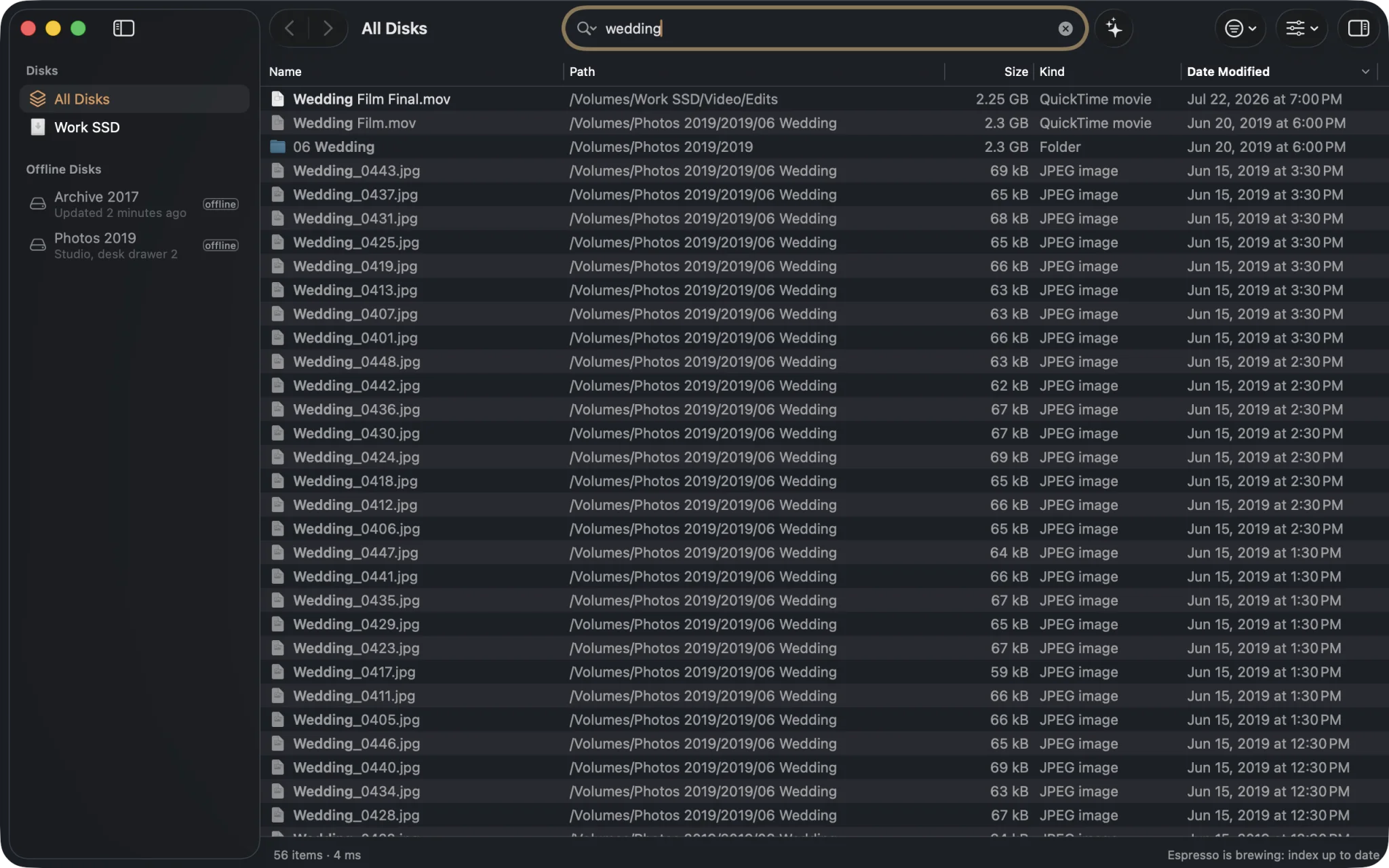
Unplug an indexed disk and it moves to Offline Disks in the sidebar, in grey, with the date of its last update. Its index stays on your Mac: search it, browse it, get info about its files. Reconnect it and Espresso catches up with any changes, then moves it back under Disks.
Opening a file needs the disk: Espresso tells you which one to connect. See Files on offline disks.
In Espresso Free
Espresso Free keeps your two most recently connected offline disks searchable. Others stay indexed but locked, marked with a lock in the sidebar (“in the cellar”); nothing is deleted. Connect one and it’s searchable again right away. With Espresso Pro, all of them are.
The disk menu
Right-click a disk in the sidebar:
| Item | What it does |
|---|---|
| Rename… | Give the disk a label in Espresso. The disk itself isn’t renamed. Handy for look-alike backup drives. |
| Disk Info… | Format, capacity, items and label; with Pro, where it’s kept and its photo. More below. |
| Update Index | Check the whole disk for changes now, without starting over. |
| Fresh Grind | Rebuild the disk’s index from scratch. Use it after changing excluded folders. |
| Pause / Resume / Stop Grinding | While the disk is being indexed. |
| Show Timeline | Pro What was added, changed or deleted on this disk. See Timeline. |
| Show in Finder | Open the disk in Finder (connected disks). |
| Folders Couldn’t Be Read… | Folders that were skipped because they need Full Disk Access. |
| Remove Index… | Forget the disk. No files are deleted, and you can index it again later. |
Disk Info
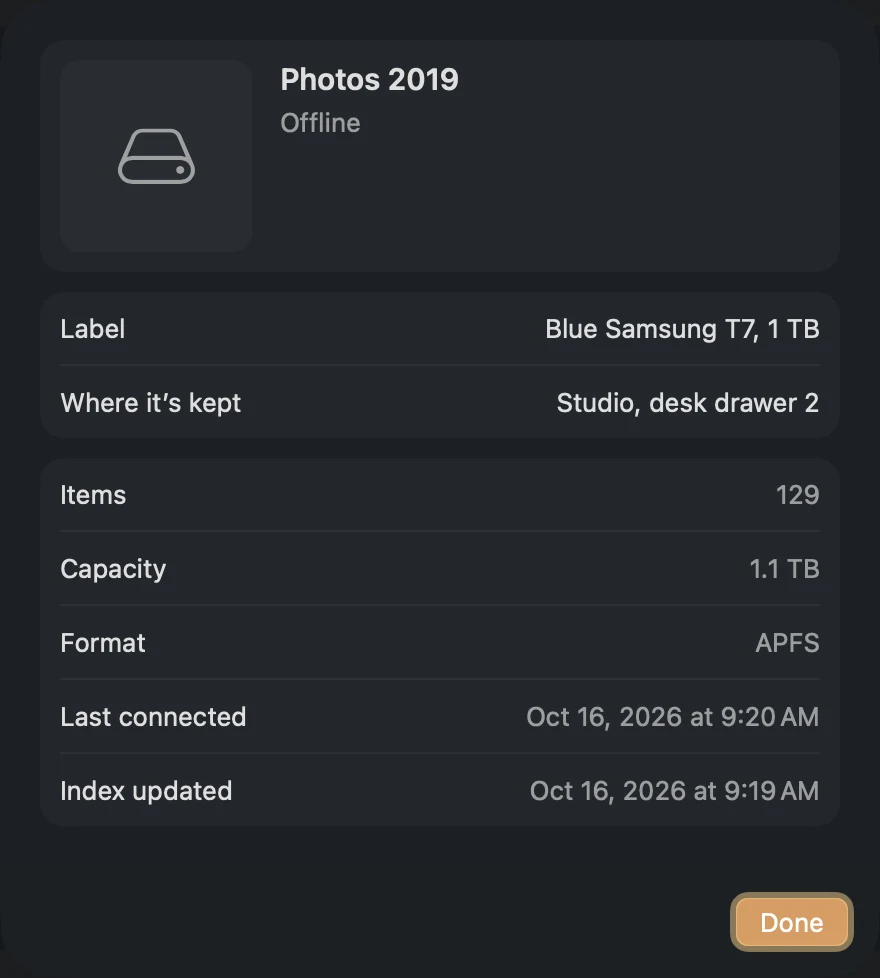
Right-click a disk › Disk Info… shows its format, capacity and number of items, and lets you set the label Espresso uses.
With Espresso Pro you can also note where it’s kept (“Studio, desk drawer 2”), drop in a photo of the disk, and see when it was last connected and how much space was free then. Where it’s kept appears under the disk’s name in the sidebar, so you know which drawer to open.
Excluded folders (Decaf)
Keep folders out of the index (build folders, caches, private folders) in
Settings › Disks › Decaf · Excluded folders. Click + and choose folders, or tick common
names such as node_modules, .git, DerivedData, .build, Pods, __pycache__, .venv and
target to skip them wherever they are.
The folders themselves still appear in results; their contents don’t. Changes apply the next time a disk is updated. Choose Fresh Grind to apply them right away.
Hidden files and packages
Hidden files, and everything inside hidden folders such as ~/Library, are always indexed but
not shown, like in Finder. Show them with Show Hidden Files (⇧⌘.),
with Lungo (⌥⌘L), with hidden: in a search, or always from
Settings › Search.
The contents of apps and other packages (for example Photos Library.photoslibrary) are
indexed and shown by default; you can hide them in Settings › Search.
Folders Espresso can’t read
- Folders protected by privacy settings (Mail, Messages, Safari, other apps’ data…) need Full Disk Access. Until you grant it, the status bar says how many folders were skipped, and Folders Couldn’t Be Read… in the disk menu lists them.
- Folders reserved for macOS, protected by System Integrity Protection or owned by system services, can’t be opened by any app, Finder included. Espresso skips them silently.
Network volumes
Shared folders on other computers and NAS drives (SMB, NFS) are off by default. Turn on Index network volumes in Settings › Disks. They can take a long time to index and may not report changes, so use Update Index when you need them fresh, or, with Pro, let Espresso update them every hour, 6 hours or day.
How much space the index takes
About 110 bytes per file: roughly 230 MB for two million files. It lives on your Mac, in
~/Library/Application Support/Espresso.